
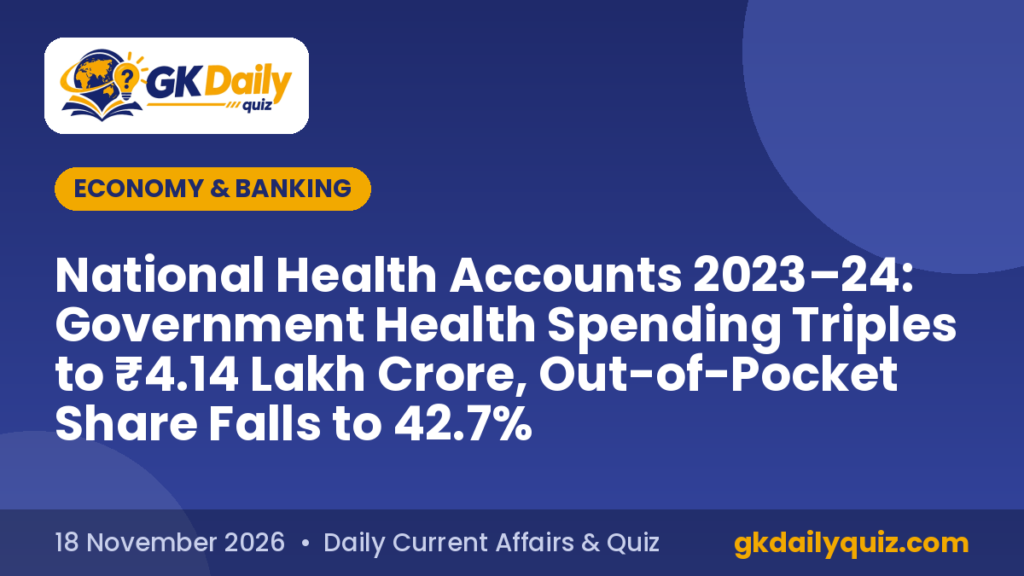
National Health Accounts 2023–24: Government Health Spending Triples to ₹4.14 Lakh Crore, Out-of-Pocket Share Falls to 42.7%
Key points for exams
- NHA estimates for 2023–24 released by the Union Health Ministry on 15 November 2026
- Government health expenditure: over ₹4.14 lakh crore, up from about ₹1.30 lakh crore in 2013–14
- Out-of-pocket expenditure: 42.7% of total health spending, down from 64.2% in 2013–14 and 43.4% in 2022–23
- Per person government health spending: ₹2,959, up from ₹1,042
- Social security share of health spending up from 6% to 11%
- Private health insurance share up from 3.4% to 10.2%
- Prepared by the NHA Technical Secretariat at NHSRC using the System of Health Accounts 2011 framework
In short: India’s governments are paying a much bigger share of the country’s health bill than they did ten years ago. The latest National Health Accounts (NHA) estimates, for 2023–24, show public health spending has roughly tripled, while the share families pay from their own pocket has dropped sharply.
What the numbers say:
• Government health expenditure (GHE): over ₹4.14 lakh crore in 2023–24, compared with about ₹1.30 lakh crore in 2013–14.
• The government’s share of total health spending rose by 14.9 percentage points over the decade.
• Out-of-pocket expenditure (OOPE): 42.7% of total health spending, down from 64.2% in 2013–14. The fall from 2022–23 (43.4%) was small, which shows the pace has slowed.
• Per person government health spending: ₹2,959, up from ₹1,042.
• Primary healthcare: public spending of about ₹1.53 lakh crore.
• Social security spending on health (government insurance like Ayushman Bharat PM-JAY, state schemes and health cover for government staff): 11% of total health spending, up from 6%.
• Private health insurance: 10.2%, up from 3.4%.
What is “out-of-pocket” spending? It is money a family pays directly at the time of treatment, for doctor fees, medicines or tests, without insurance or a government scheme covering it. A high OOPE pushes poor families into debt, so lowering it is a key goal of health policy.
Why the change: the Health Ministry credits Ayushman Bharat (PM-JAY insurance and Ayushman Arogya Mandirs), Jan Aushadhi Kendras for cheap generic medicines, and free drugs and diagnostics in government hospitals.
What still needs work: a 42.7% OOPE is still high by global standards, and the slower fall in the last year suggests the next gains will be harder. The National Health Policy 2017 set a goal of raising public health spending to 2.5% of GDP by 2025.
About the NHA: the estimates are prepared by the National Health Accounts Technical Secretariat (NHATS) at the National Health Systems Resource Centre (NHSRC), New Delhi. They follow the WHO-backed System of Health Accounts 2011 framework, so India’s figures can be compared with other countries. This is the 11th round of NHA estimates for India.
Quick facts: Ayushman Bharat was launched in 2018. Health is a State subject in the Constitution’s Seventh Schedule, so both the Centre and the states spend on it.
Source: Ministry of Health and Family Welfare, All India Radio News
Practice questions 5
Tap an option to check your answer.
-
1According to NHA 2023–24, what share of total health spending was out-of-pocket expenditure?
Correct answer: A. OOPE fell to 42.7%; it was 64.2% in 2013–14 and 43.4% in 2022–23.
-
2Government health expenditure in 2023–24 was over how much?
Correct answer: B. It rose to over ₹4.14 lakh crore from about ₹1.30 lakh crore in 2013–14.
-
3Which body prepares India's National Health Accounts estimates?
Correct answer: C. NHATS at the National Health Systems Resource Centre prepares them for the Health Ministry.
-
4Per person government health spending in 2023–24 was about:
Correct answer: D. It rose from ₹1,042 in 2013–14 to ₹2,959.
-
5The National Health Policy 2017 aimed to raise public health spending to what share of GDP by 2025?
Correct answer: A. NHP 2017 set a target of 2.5% of GDP for public health spending by 2025.
Related current affairs

15-Year-Old Vaibhav Sooryavanshi Smashes 204 off 53 Balls, Fastest Hundred and Double Hundred in List A Cricket
Vaibhav Sooryavanshi, 15, scored 204 off 53 balls for India A against the UAE in the Asia Cup Rising Stars in Doha…

West Bengal Cabinet Approves Renaming the State ‘Paschim Banga’; Resolution in Assembly on 9 December
The West Bengal Cabinet has approved a proposal to rename the State 'Paschim Banga', Chief Minister Suvendu Adhikari said on 23 November…

Europe–Japan Mission BepiColombo Enters Orbit Around Mercury After an Eight-Year Journey
BepiColombo, a joint mission of the European Space Agency (ESA) and Japan's JAXA, entered orbit around Mercury on 21 November 2026, eight…
RBI Proposes a ‘Stop Switch’, Custom Payment Limits and a Trusted Person Check to Fight Digital Fraud
The Reserve Bank of India on 23 November 2026 released draft rules that would let bank customers block all outgoing digital payments…